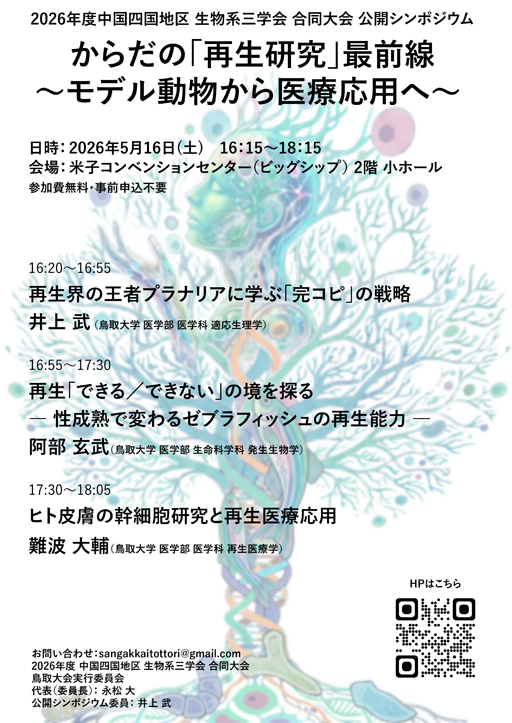
Frontiers in Regeneration Research – From Model Animals to Medical Applications –

Public Symposium, Chugoku-Shikoku Joint Meeting of the Three Biological Societies 2026
On Saturday, May 16, we organized a public symposium entitled “Frontiers in Body Regeneration Research – From Model Animals to Medical Applications –.” I also gave the first presentation, in which I introduced regeneration in planarians.
S-1. The Strategy of “Perfect Copying” from Planarians, the Champions of Regeneration Dr. Takeshi Inoue Department of Adaptive Physiology, School of Medicine, Faculty of Medicine, Tottori University S-2. Exploring the Boundary Between Regenerative and Non-Regenerative States Changes in Regenerative Capacity Associated with Growth and Sexual Maturation in Zebrafish Dr. Genbu Abe Department of Developmental Biology, School of Life Sciences, Faculty of Medicine, Tottori University S-3. Human Skin Stem Cell Research and Its Applications in Regenerative Medicine Dr. Daisuke Namba Department of Regenerative Medicine, School of Medicine, Faculty of Medicine, Tottori University
For many people, the word “regeneration” may evoke extraordinary abilities found in stories, or advanced medical technologies such as regenerative medicine. In the life sciences, however, regeneration research addresses a fundamental question: how living organisms respond to injury, maintain their bodies, and, when necessary, rebuild tissues and organs.
This symposium featured studies on whole-body regeneration in planarians, changes in regenerative capacity during growth and sexual maturation in zebrafish, and human skin stem cell research and its application to regenerative medicine. Although these topics involved different organisms and systems, a common theme emerged: regenerative capacity is not determined solely by the properties of cells themselves, but is regulated by factors such as positional information, hormones, the tissue environment, and aging.
Regeneration research has moved beyond simply describing which organisms can regenerate. The field is now asking why regeneration is possible, why it becomes limited or lost, and how regenerative processes can be controlled. At the same time, regeneration cannot be reduced to a single mechanism. Whole-body regeneration, organ regeneration, and tissue repair each involve different cell types, positional cues, tissue environments, and systemic conditions. Even within the same organism, the mechanisms involved can differ depending on which body part is being regenerated. This diversity of regenerative phenomena is important for understanding body formation, responses to the environment, life history, and medical applications in an integrated way. For this reason, regeneration was a highly appropriate theme for a joint meeting of the botanical, zoological, and ecological societies.
The symposium was attended not only by society members, but also by high school students participating in the meeting and members of the general public. We were pleased to conclude the session successfully, with strong attendance and active interest. We sincerely thank everyone who joined us.